


There is a story many ambitious people tell themselves about how lasting success happens. It goes something like this: you work hard enough, someone important notices, the recognition arrives, and from that point, everything compounds. The speaking invitations come in. The clients follow. The media mentions accumulate. And success, finally, is yours.
The problem with that story is not the ambition inside it. The problem is the location. It places success in the moment of recognition, as though the spotlight is where the building happens, and not merely where the announcement is made.
Lasting success is not built in the spotlight. It is built in the two periods the spotlight does not illuminate.
- The Two Periods That Determine Lasting Success
- The First Silent Period: Before the Spotlight Arrives
- The Second Silent Period: After the Spotlight Fades
- Building for What Lasts
The Two Periods That Determine Lasting Success
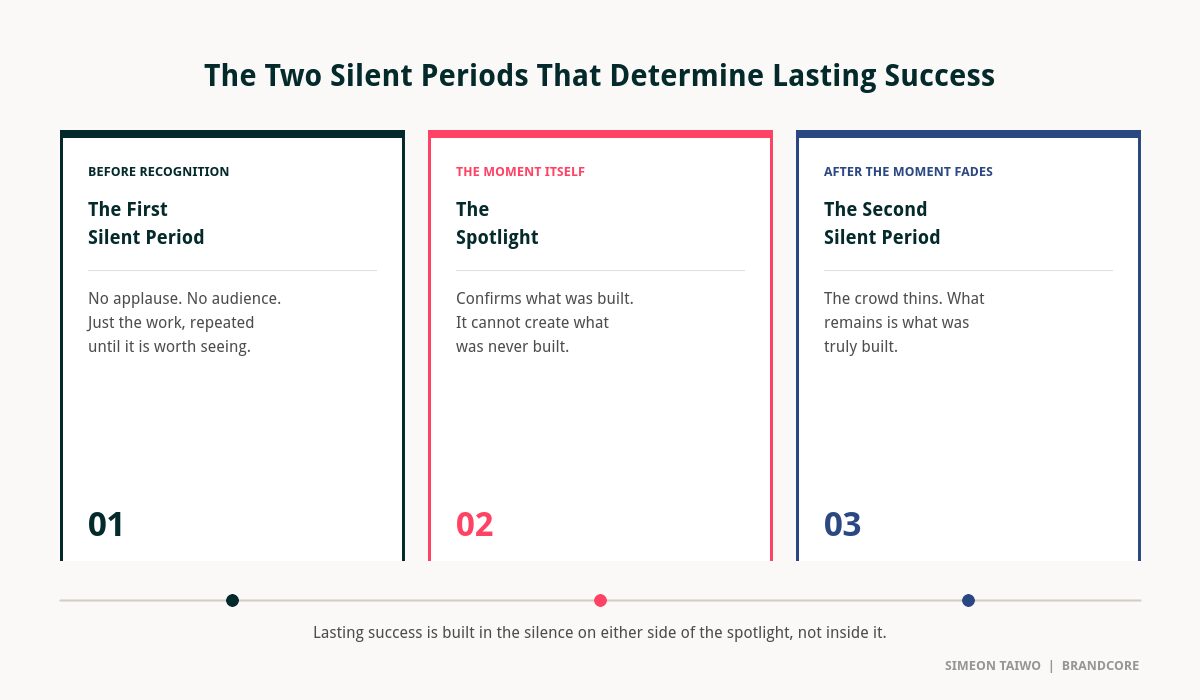
Before recognition arrives and after it fades, these are the periods most people are never warned about. They are also the periods that separate what lasts from what merely happens.
Understanding them will not make the work easier. But it will make it more deliberate.
The First Silent Period: Before the Spotlight Arrives
This is the period nobody celebrates. No applause, no media coverage, no affirmation from the people whose approval feels most significant. Just you, your work, and the uncomfortable silence of building something nobody has yet told you is worth building.
This is where most people stop. Not because the work is impossible, but because the silence begins to feel like a verdict. The absence of recognition reads as the absence of progress. And because the stage is empty, the temptation is to find a stage that already has an audience, even when the work performed there is not yet ready to be seen.
But the first silent period is not a waiting room. It is a construction site.
The discipline it demands is building to the same standard you would apply if a thousand people were watching, in a season when nobody is. The conviction it demands is producing work you believe in before external evidence arrives to confirm the belief. The character it demands is the refusal to interpret silence as failure.
This is also the period when the temptation to prove yourself is loudest. When mockery arrives, when peers move faster, when it feels like the world has moved on and left you in a room nobody visits. And the moment you switch from building to proving, your growth stalls. Not because you have stopped moving, but because proving faces backward, toward critics, while building faces forward, toward the work. You cannot do both at the same time.
Every builder whose name you now recognise lived this period. The years before the recognition. The projects that produced nothing measurable. The convictions held in the absence of evidence. The first silent period is where lasting success is born, quietly and without ceremony. The spotlight will one day reveal what was built here. But the spotlight cannot create what was never built.
The Second Silent Period: After the Spotlight Fades
If the first period is about building before the world pays attention, the second is about proving that what was built has genuine value after the world stops paying attention. And the spotlight always moves on.
Many people are not prepared for this. The announcement was made. The celebration happened. The posts were shared, the invitations came, and then, as is the nature of every spotlight moment, the attention shifted. The crowd went back to their business. The mentions dried up. The invitations slowed.
What remained was exactly what was built before recognition came.
This is the period that answers a question that was always waiting to be answered: did you build a solution, or did you build a season?
A season lives on attention. It is alive because the crowd is gathered, because there is momentum, because the energy is high. Remove the attention, and there is nothing left to sustain it. Many careers are seasons, significant in the moment, quiet in a particular way when the moment ends.
A solution lives on utility. People return to it because it solves a real, specific problem for them. Not because it is trending, not because they saw someone else use it, but because their pain is relieved by it and that is reason enough. This is the same discipline behind the deliberate practice research published in Harvard Business Review: expertise is never the by-product of a moment, it is the residue of years nobody was watching. A solution does not require the crowd to stay alive. The crowd can thin, the excitement can fade, and the people who need what it does will keep returning.
The second silent period is the verdict on which of those two things you built. Lasting success shows up in this period as something people still reach for when the novelty is gone and the original excitement is a memory. What does not survive this period was not success. It was a season.
The Problem With Chasing the Stage
Many ambitious people confuse the announcement with the achievement. They chase speaking engagements, media mentions, and high-table invitations as though the platform is the proof. But the platform’s job is to amplify, not to create. A weak foundation amplified is still a weak foundation, and the platform will not apologise for exposing it.
Real work is not built on platforms. It is built in the quiet, sometimes tedious, often lonely hours that nobody will give you a standing ovation for. The research nobody asked you to do. The system you built when you had no clients to deploy it for. The product you kept refining when the numbers were still embarrassing. The content you published when the reach was flat and the comments were few.
None of those hours are glamorous. But they are the only hours that compound into something that outlasts the excitement.
Think about Tony Elumelu, whose first decade of serious institutional work was invisible to the public conversation in Nigeria. Think about Mo Abudu, who spent years in human resources and executive training before AfricaMagic and EbonyLife gave her a name most Nigerians now know instantly. The spotlight confirmed what had already been built in the silence. It did not create it.
If you want to understand the internal work that shapes what gets built in those silent periods, my post on the Success Programming framework is a useful companion to this one. The programming installed before recognition arrives is what determines whether the build survives the second silence. And if the temptation you are fighting is the pull toward novelty over mastery, the Repetition vs. Adventure principle explains why the builders who last are rarely the ones chasing the newest thing.
Building for What Lasts
The question that matters is not whether people are watching. It is what you are doing when they are not.
Lasting success is made entirely in the two silent periods. The spotlight is not the work. It is the confirmation of work. And it can only confirm what was genuinely built before it arrived.
This means the seasons of your building life that you are most tempted to shortcut are also the seasons that matter most. The unvalidated years before recognition arrives. The quiet years after the excitement fades. These are not periods to survive. They are the only periods where lasting success is actually created.
Build in the silence. Build with the same standard you would apply if the room were full. In the seasons when it is not, and also in the seasons when it is no longer.
The spotlight will find you eventually. What matters is what it finds when it does.
If you are in a season of building without recognition and want clarity on whether what you are building is positioned for genuine, lasting success, Brand Clarity Coaching is a good place to start that conversation.