


Last quarter, a founder I was consulting for automated three of his business’s most repetitive processes. Project timelines that used to take a full workweek dropped to a few hours. Proposals that used to take days started taking minutes. He expected some room to breathe.
His calendar did not agree. If anything, it got fuller.
He could not explain it at first. The tasks had gone. The work had reduced. But he was still the busiest person in his own company, and it took him a while to see why.
He had not freed himself. He had only freed his team. He had walked straight into the AI leadership bottleneck, the gap that opens when execution is removed but the thinking and standards beneath it are never transferred. Everything that always needed his input was still untouched. The judgement calls. The exceptions. The decisions that start with someone saying, this does not look right, fix it your way. AI could not touch any of that.
Table of Contents
The question nobody is asking honestly
Every conversation about AI in business right now asks the same thing. How much time can it save? How much faster can it make us? How much of the workload can it take off our hands?
Almost nobody is asking the question underneath that one. Did the leadership ever build a team able to carry that weight in the first place? Because if it did not, AI does not close that gap. It only exposes it, and this is the real AI leadership bottleneck most business owners have not named yet.
Research from McKinsey on Africa’s generative AI opportunity makes the same observation from the outside: African businesses are moving fast on adoption, but the structural leadership gaps underneath that adoption remain largely unaddressed. The tools are arriving before the thinking infrastructure is built to receive them.
The AI leadership bottleneck: three layers nobody talks about
Every task a team performs actually sits on three layers, whether anyone has named them or not.
The first is the task layer. This is what to do. Draft the proposal. Design the graphic. Prepare the report. AI is extremely good at this layer, and it is the layer most workplace training focuses on almost exclusively.
The second is the thinking layer. This is how the decision behind the task actually gets made. Why this client gets a different tone. Why this exception gets approved and another does not. This cannot be copied from a manual. It has to be transferred, person to person, over time.
The third is the standard layer. This is what “good” is supposed to look like when the work is genuinely done right, not just finished. Most team members can tell you what to do. Far fewer can tell you, without being asked, whether what they produced actually meets the standard the business was built on.
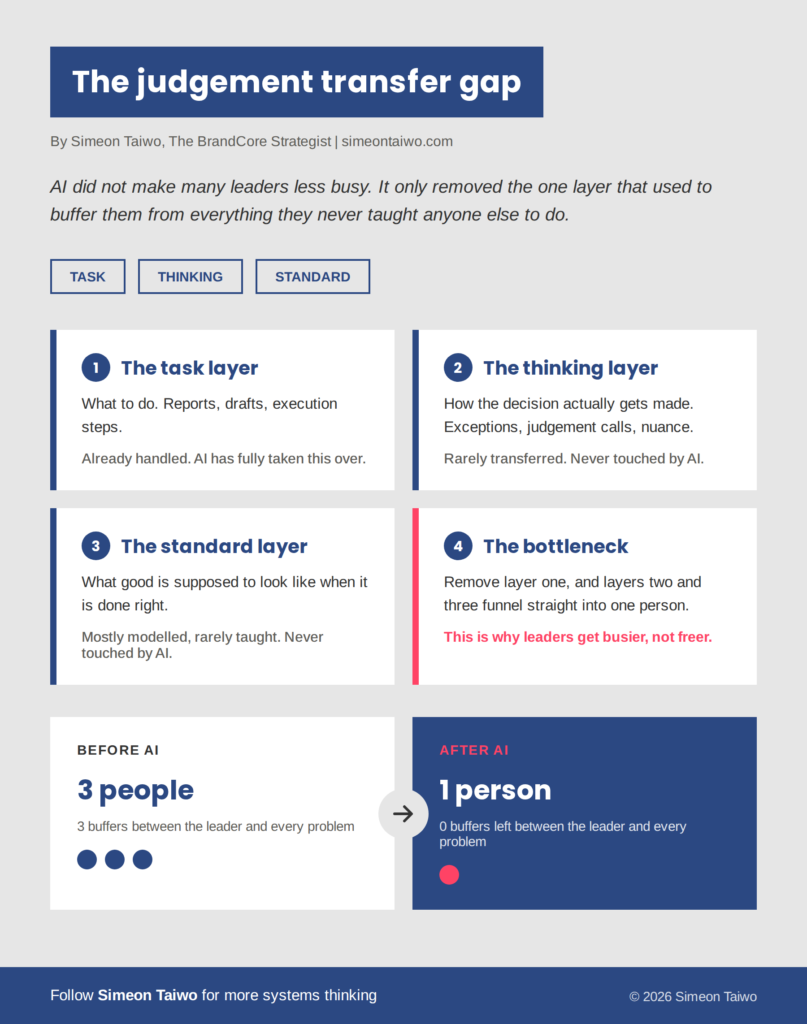
The sad truth is that most leaders only hand over layer one. They train their people to execute. They rarely train their people to think the way they think, or to hold the standard they hold. So the day AI shows up and swallows layer one whole, the leader does not get less busy. Only the team does. The leader is still left holding layers two and three, which were always the leader’s job alone. That sequence is the AI leadership bottleneck at its simplest: remove layer one, and layers two and three funnel straight back into you.
Why I closed this gap before AI ever came onto the scene
This is exactly why I have never trained my own team on tasks alone, and it was never even about AI.
The year I started working with paid interns, long before AI came onto the scene, I noticed something. If I still had to check every document, every flyer, every blog post after they had finished it, that was not saving me time. If I still had to hover over every project just to protect the standard, that was not saving me time either. I was still doing the work.
So I built my training around thinking, taste, and decision frameworks long before it became fashionable to talk about AI-proofing a business. Whenever I train anyone on design for Clarylife, I first ask them to send me designs they feel are beautiful and good enough. That single exercise exposes their taste to me, and I start my training from there, not from a checklist of tools or techniques.
Over time, that same approach shaped how we built the Clarylife Brand OS, to give any team member access to the thinking layer and the standard layer without needing me in the room for every decision.
That founder I mentioned earlier is only discovering his gap now, with AI as the trigger. I closed mine years ago, one intern at a time, long before there was a name for the problem.
What this means for your business
If you have automated part of your operations recently and found yourself busier instead of lighter, this is very likely why. It is not a failure of the automation. AI does not close that gap in your system. It only exposes the AI leadership bottleneck that was already present before any tool arrived.
If you only got busier after automating your operations, that is the clearest indication that you never built a working system. You only had human robots, people executing steps without ever being trained to think or to protect a standard the way you would.
AI is not the problem, and it will not become the problem no matter how advanced it gets. It will only ever be as useful to your business as the judgement infrastructure already standing underneath it. Build that infrastructure early, and AI genuinely frees up capacity. Skip it, and AI simply removes the last buffer between you and total dependency.
The place to start is an honest audit. Not of your tools, but of what your team can actually think through without you in the room, and what still cannot move without your judgement attached to it.
If you want to build that judgement transfer deliberately, inside a structured system rather than by trial and error the way I had to figure it out with my first interns, that is exactly what we work through inside the Clarylife Mentorship Academy’s Systems Thinking and AI-Driven Innovation track. Closing the AI leadership bottleneck is the real work, and CMA is not currently admitting. The next cohort opens in April. Join Simeon’s Clarity Network to be notified the moment applications open.
I remain your BrandCore Strategist.