

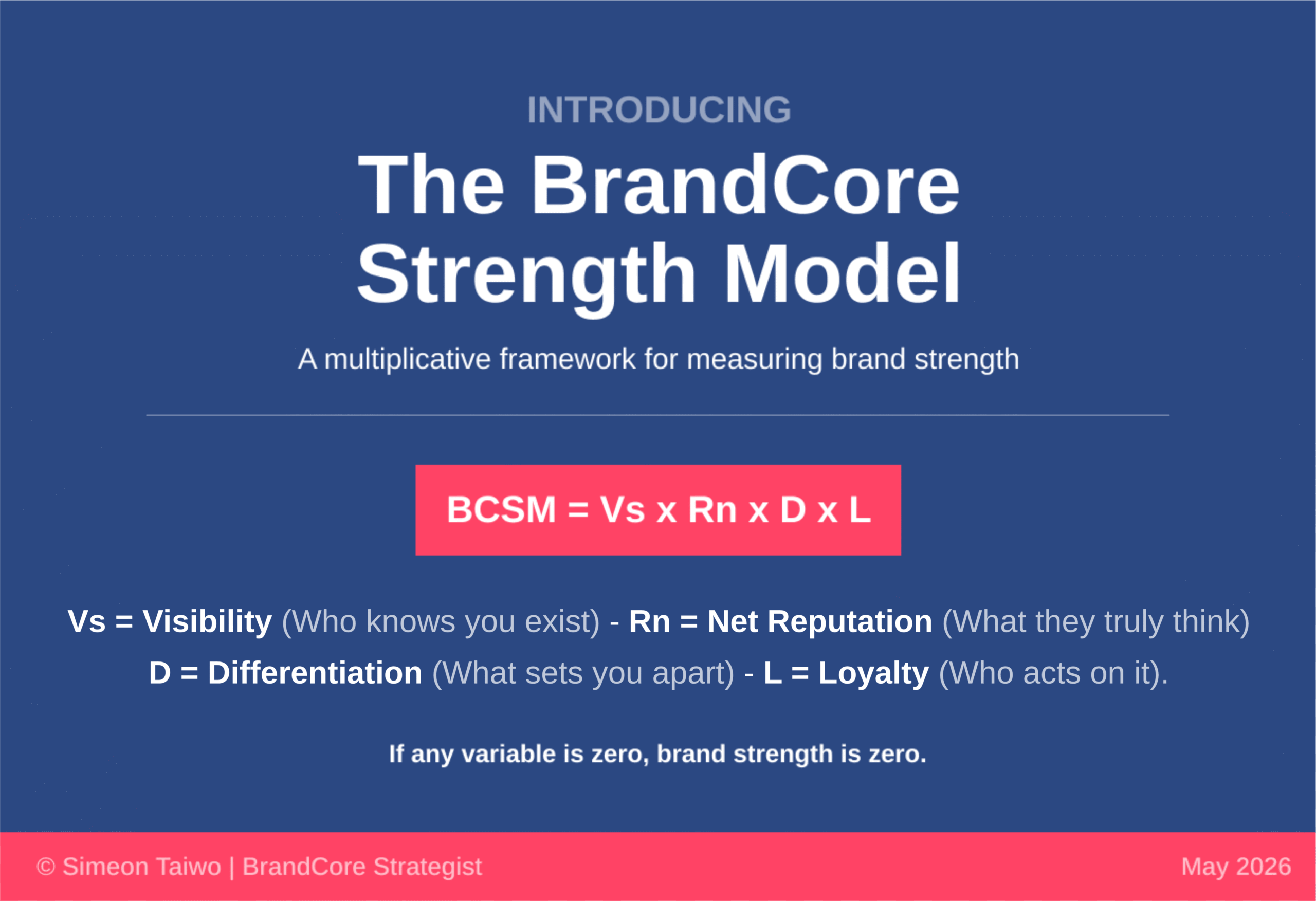
The BrandCore Strength Model is a multiplicative framework I developed to equip businesses of any size and budget level to measure their Brand Strength and also give them the right evaluative and diagnostic tools to know what key levers to move in order to see an improvement in their Brand Strength.
Now, think about the last time someone asked you how strong your brand is.
What did you say? Did you talk about your logo? Your Instagram followers? How many people attended your last event? Or did you pause, because you realised you did not actually have a number?
Most business owners cannot answer this question. Not because they are careless, but because nobody has given them a tool that makes the answer computable. We talk about brand strength in feelings. In impressions. In vibes. And then we wonder why branding feels like guesswork.
I have spent years thinking about this problem. Not from the outside, as a theorist. From the inside, as a practitioner building brands in the Nigerian market, where trust is the scarcest commodity and the margin for error is razor-thin.
Years ago, I built a simple formula. Brand Strength equals Visibility multiplied by Reputation. It made sense to me then, and the logic holds: if nobody knows you, your brand strength is zero. If everybody knows you but nobody respects you, your brand strength is still zero. Both conditions must be present. You need to be seen, and what people see must be worth remembering.
I set the formula aside and moved on to other work. Recently, I came back to it. And when I did, I discovered two things.
First, the foundational insight was right. The multiplicative relationship between visibility and reputation is sound, and it has been validated independently by others. Lee Frederiksen of Hinge Marketing published the same core equation in 2009. Fajen Consulting also articulated it in 2025. The Attest Brand Index uses similar logic. This is not a coincidence. When multiple practitioners arrive at the same structural truth independently, it usually means the truth is real.
Second, the formula was incomplete.
Two variables are not enough to capture what brand strength actually is. Visibility and Reputation tell you whether people know you and whether they think well of you. They do not tell you whether those people can distinguish you from every alternative in the market. They do not tell you whether thinking well of you translates into actually choosing you. And they do not account for the fact that negative perception is not simply the absence of positive perception. It is an active force working against you.
So I built what the original formula was always meant to become.
The BrandCore Strength Model
The BrandCore Strength Model (BCSM) measures brand strength through four variables, not two. Each one captures a dimension of brand equity that the others cannot replace. And because they are multiplied together, not added, the model enforces a truth that most frameworks avoid: if any single dimension is zero, your brand strength is zero. You cannot compensate for invisibility with loyalty. You cannot compensate for a terrible reputation with high visibility. All four must be present.
Here are the four variables.
Variable 1: Visibility (Vs)
What percentage of your addressable market knows you exist?
Not the entire world. Not your city. Your addressable market. The specific group of people who could realistically become your customers. If you are a bakery in Port Harcourt, your addressable market is not the entire population of Rivers State. It is the people within a defined radius who buy baked goods.
Visibility is measured as a percentage: 0% means nobody in your market has heard of you. 100% means everyone has.
This is the Awareness stage of the brand journey. It is where everything begins.
Variable 2: Net Reputation (Rn)
Of the people who know you exist, what is the net quality of what they think about you?
This is where the model departs from everything that came before it. Previous formulas measured reputation as a single positive number: what percentage of people who know you think well of you? That approach treats someone who has never heard of you and someone who actively tells their friends to avoid you as the same thing. They are not.
In a market like Nigeria, where WhatsApp is the real review platform and a single bad experience travels faster than any advertisement, negative perception is not a neutral absence. It is an active force withdrawing from your brand’s account.
The BCSM uses a net formulation. Take the percentage of your aware audience with positive perception and subtract the percentage with negative perception.
If 40% of the people who know you think well of you and 15% think poorly of you, your Net Reputation is 25%. If those numbers are equal, your Net Reputation is zero. Your brand is at war with itself.
Let me make this practical. Say 100 people in your target market know your brand exists. Of those 100, 40 think well of you. They would recommend you. They speak favourably when your name comes up. That is your positive group: 40%.
Another 15 have had a bad experience or heard something negative. When your name comes up, they warn people away. That is your negative group: 15%.
The remaining 45 are neutral. They know you exist but have no strong opinion either way.
Your Net Reputation is 40% minus 15% = 25%.
Now compare that to a second brand. Same market. Same 100 people aware of them. Same 40 people with positive perception. But zero negatives. Sixty neutrals.
Their Net Reputation is 40% minus 0% = 40%.
Both brands have the exact same number of fans. But the second brand is nearly twice as strong in reputation, because nobody is actively working against it. The old way of measuring reputation would give both brands the same score: 40%. The BrandCore Strength Model reveals the real difference.
And if those numbers were ever equal, say 30 positive and 30 negative, your Net Reputation is zero. Not because nobody has an opinion. Because the opinions are cancelling each other out. Every person speaking for you is being neutralised by someone speaking against you. That is a brand at war with itself.
Variable 3: Differentiation (D)
Of the people who know you, what percentage perceives you as genuinely different from every available alternative?
You can be visible and well-liked and still be interchangeable. Think about it. Five restaurants on the same street. All known. All decent. None distinct. The moment one of them drops its price, everyone else loses customers. That is the cost of zero differentiation.
Research from Kantar (formerly Millward Brown), conducted across thousands of brands globally, has consistently shown that differentiation is the single strongest predictor of a brand’s ability to charge premium prices and sustain long-term growth. Stronger than awareness. Stronger than general favorability.
Young & Rubicam‘s Brand Asset Valuator included differentiation as one of four pillars decades ago. But it was never placed inside a computable formula. The BCSM puts it there. If your differentiation is zero, your brand strength score is zero. Because an interchangeable brand is not a brand. It is a commodity waiting to be undercut.
Variable 4: Loyalty (L)
Of the people who know you and think well of you, what percentage actually acts on it?
This is the question most brand conversations avoid. Because the answer is often uncomfortable. People can admire your brand from a distance, share your posts, compliment your work, tell you they love what you are doing, and never buy. Never refer. Never come back.
Loyalty is measured among the positive-perception group, not the entire market. Because loyalty is only possible where positive perception already exists.
A brand can be visible, well-regarded, and differentiated, and still fail if none of that translates into behaviour. Loyalty is the evidence that brand strength has crossed the threshold from something people think to something people do.
The Formula
Here it is.
BCSM Score = (Vs/100) x ((Rn+100)/200) x (D/100) x (L/100) x 100
The output is a score between 0 and 100. And the multiplication means that a zero anywhere produces a zero everywhere.
A Worked Example
A professional services brand in Port Harcourt. Addressable market: 500 business decision-makers.
Visibility: 150 of 500 know the brand. That is 30%.
Net Reputation: Of the 150 aware, 60 are positive (40%), 20 are negative (13.3%). Net Reputation = 26.7%. To bring this onto the same scale as the other variables, we adjust: (26.7 + 100) divided by 200 = 0.6335. In plain terms, this brand’s reputation is operating at about 63% of its full potential.
Differentiation: 45% of the aware population sees the brand as distinctly different from alternatives.
Loyalty: Of the 60 people with positive perception, 25 have purchased more than once or referred others. That is 41.7%.
BCSM Score = 0.30 x 0.6335 x 0.45 x 0.417 x 100 = 3.57.
That is a low score. And it should be. A brand at 30% visibility with moderate differentiation is an early-stage brand. But the number is not the point. The decomposition is. Now you know exactly where the constraints are: Visibility and Differentiation. That is where the work needs to happen. Not everywhere. There.
What Your Score Pattern Tells You
The BCSM does not just give you a number. It gives you a diagnosis. Different combinations of high and low scores across the four variables reveal specific brand conditions, each with its own prescription.
If your Visibility is low but everything else is strong, you are The Invisible Brand. You deliver well. Those who find you love you. But not enough people know you exist. The prescription is reach, not refinement.
If your Visibility is high but your Net Reputation is low or negative, you are The Controversial Brand. You are visible for the wrong reasons. The prescription is not more marketing. It is fixing the root cause of negative perception.
If your scores are moderate across Visibility and Reputation but Differentiation is low, you are The Commodity Brand. Known, liked, interchangeable. The prescription is sharper positioning. A clearer point of view (PoV).
If everything looks strong except Loyalty, you are The Admired Stranger. People know you, respect you, recognise what makes you different, and still do not buy. The prescription is not better branding. It is a better conversion mechanism, a lower-friction entry point, a clearer call to action (CTA).
If Loyalty is declining while everything else holds steady, you are The Leaky Bucket. You are acquiring new audience but losing existing ones. Something in the ongoing experience is breaking down.
Each of these is a different problem requiring a different solution. A single composite score cannot tell you which one you have. Four decomposed variables can.
Where This Sits in the Existing Body of Knowledge
I want to be clear about what is mine and what is not.
The insight that brand strength is a function of visibility and reputation, in a multiplicative relationship, is not new. Frederiksen published it in 2009. Others have echoed it since. I arrived at the same logic independently, but I am not the first to articulate it, and intellectual honesty requires saying so.
What the BCSM contributes is the completion of that insight. The extension from two variables to four. The net reputation formulation that accounts for the destructive power of detractors. The integration of differentiation into a computable formula, bringing decades of validated research from Kantar and Young and Rubicam into an accessible equation. The diagnostic pathology layer that connects score patterns to recognisable brand conditions. And the integration of the model with a coherent body of brand theory I have developed over years of practice in the Nigerian market, including the Awareness-Experience-Memory brand journey, the Three Cardinals of Every Solid Brand, the Suspect-to-Trusted trust sequence (detailed in my book, From Suspect to Trusted, 2026), and the Trust Growth Model, all of which I teach through BrandingSchool.NG and have published across my body of work.
The existing frameworks are the shoulders. The BCSM is what I am building from that vantage point.
What Comes Next
This is Version 1.0. The full technical publication, with detailed measurement methodology, score benchmarks, and the complete integration architecture, is being prepared for formal release through BrandingSchool.NG.
Beyond the publication, the BCSM is being developed into a software tool that will allow any business owner to define their addressable market, input their variable estimates, receive a BCSM Score, and get a diagnostic reading of their brand’s condition with specific prescriptions for improvement.
The goal is not to make brand measurement a luxury reserved for companies with six-figure research budgets. The goal is to make it accessible to the business owner in Port Harcourt, in Lagos, in Nairobi, in Accra, in Johannesburg, who knows their brand needs work but has never had a tool that tells them exactly where to start.
That is the work. And it starts here.
This publication is also accessible on Social Science Research Network (SSRN) and Zenodo.
I remain your BrandCore Strategist.
Simeon Taiwo Founder, Clarylife Global | Senior Partner, BrandingSchool.NG Author, From Suspect to Trusted (2026)