

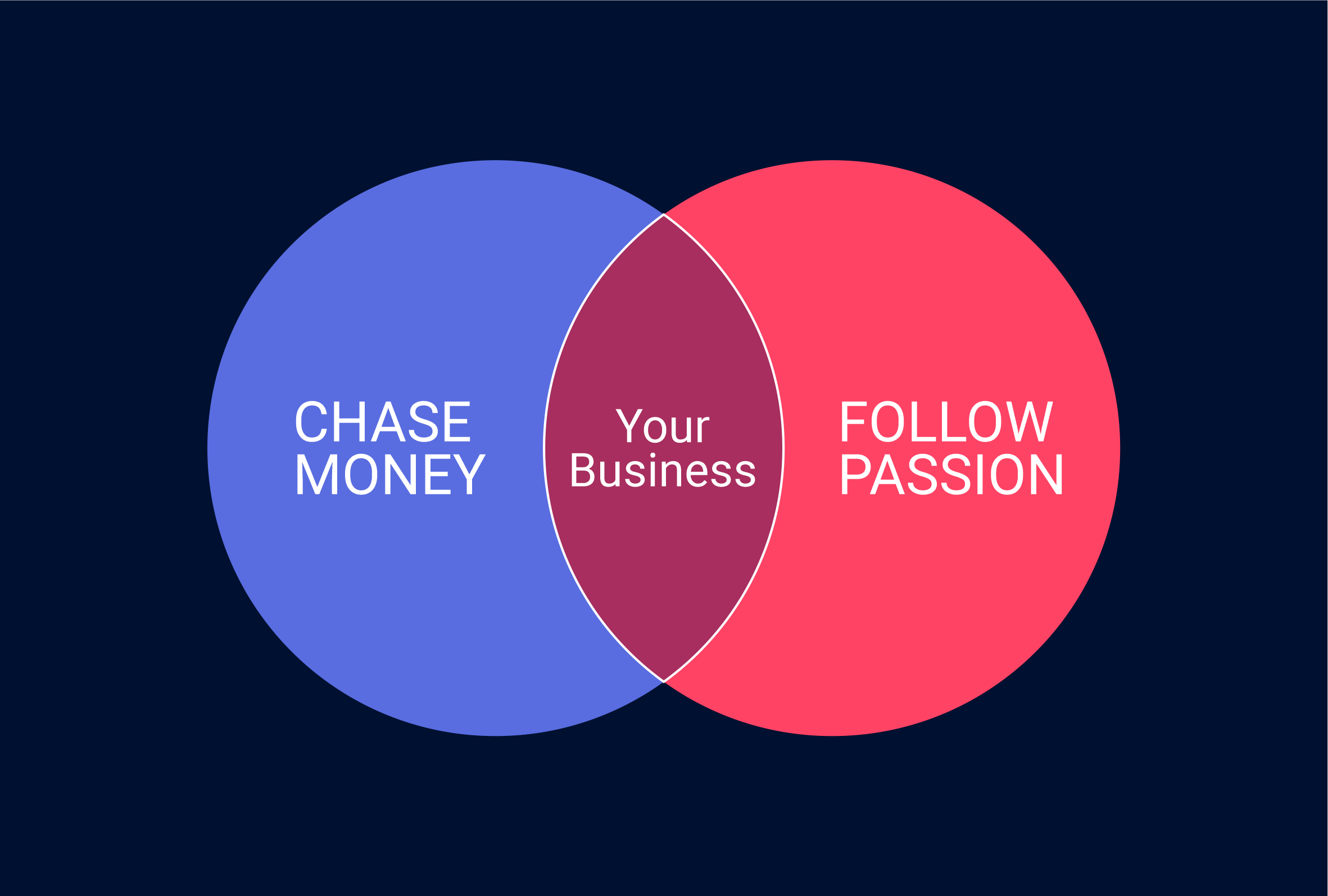
The advice to follow your passion is one of the most repeated and least examined pieces of career guidance in circulation. On the other side of the argument sits an equally confident group insisting you should follow the money, ignore what you feel, and build whatever the market will pay for. Both camps have successful people testifying on their behalf. And both camps are missing the more important question entirely.
The debate has been framed wrong from the beginning. The real question is not whether to follow your passion or follow the money. The real question is: what is your passion actually pointing toward, and is that thing capable of sustaining a business?
That distinction determines everything.
Why “Follow Your Passion” Keeps So Many People Broke
Here is the honest problem with the follow your passion instruction. Passion, on its own, is not a business strategy. It is an internal experience. The fact that you love doing something tells you absolutely nothing about whether anyone will pay you to do it, how much they will pay, or whether the market is large enough to build a sustainable living from.
No one pays you to feel good. People pay to have their problems solved. And passion says nothing about problems. Passion says, “I love this.” Purpose asks, “Who needs this, and what does its absence cost them?”
I have seen talented people invest years into a passion that, on honest examination, had no real market. They were not lazy. They were not unskilled. They were simply running on the wrong instruction, and nobody around them had the courage to ask the right questions early enough. The result was not a failed business. It was a very expensive hobby with a business card.
Here is the line I keep coming back to: irresponsible passion keeps you broke. The moment you begin to think seriously about the stakes, the market, and the actual demand behind what you love doing, you are forced to think like a business person. And that pressure is not the enemy of your passion. It is what matures it into something sustainable.
Passion Is a Compass, Not a Leader
Let me be precise about what passion actually is, because when you understand it correctly, you stop trying to build a career on it and start using it the way it was meant to be used.
Passion is a compass. It points in a direction. It tells you which problems you are energised to engage with, which environments you thrive in, which challenges feel like fuel rather than friction. That is enormous information. A compass that works correctly can save you years of misalignment. But a compass is not a leader. You do not let a compass make decisions. You use a compass to orient yourself, and then you apply judgment to everything else.
The right leader for a career or a business is not passion. It is purpose. Purpose is a more demanding thing. Purpose asks: what specific problem am I uniquely built to solve? Who carries that problem? What does my particular combination of skill, experience, and concern make me most qualified to address? Purpose is the intersection of what you love doing — your passion — and who you cannot stop thinking about — your burden for a specific set of people or a specific problem in the world.
When passion and burden overlap, and when that overlap meets a genuine market need, you are no longer choosing between following your heart and following the money. You have found the conversation those two things are trying to have with each other.
The Distinction That Actually Matters: Problem vs. Product
This is the insight I want you to carry from this post, because it changes how you see every business decision after it.
You should never be passionate about your product. You should be deeply, almost obsessively passionate about the problem your product solves.
Aliko Dangote is not passionate about salt and cement. No one sits at a dinner table describing cement with the kind of light in their eyes that we associate with passion. But Dangote is deeply passionate about industrial-scale solutions to the infrastructure problems of African economies. The cement is a vehicle. The problem is the mission. And the mission has scale, staying power, and the kind of motivation that survives difficulty in a way that product-love never could.
Tope Awotona, founder of Calendly, tried other businesses before it. They failed, and when he examined why, the honest answer was that he simply was not passionate about the problems those businesses were solving. Calendly worked because the friction it removed — the absurd back-and-forth of scheduling — was a problem he genuinely could not stop thinking about. The product was almost incidental. The problem was everything.
I know this from my own practice. I am not passionate about branding and web solutions as disciplines. I am passionate about what these things do for people, platforms, and businesses when they are done well. I am passionate about the clarity that a founder gets when their brand finally says exactly what their business means. I am passionate about the time a business owner gets back when their operations run on systems rather than on their personal presence. The brand work and the system work are how I serve those passions. They are not the passions themselves.
That distinction changes how you show up for the work, how you price it, how you weather the difficult seasons, and how long you last. Passion for a product fades when the product becomes routine. Passion for the problem only deepens as you understand the problem more.
The 3 Questions Every Passionate Person Must Answer
Here is where the follow your passion instruction fails most people: it skips the examination. It says follow, not examine. And the examination is precisely what converts a passion into a viable business.
Before you build anything around what you love doing, you need honest answers to three questions.
The first question is: what specific, named problem does this passion solve, and for whom exactly? Not a general problem. A specific one. Not a vague audience. A named one. “I love photography” is not a business. “I help Nigerian SMEs tell their brand story visually, specifically at the point when they are scaling from founder-led to team-led” is a business. The specificity is what makes you findable, hireable, and referable.
The second question is: what is the realistic size of that demand, and is it enough to build on? This is not about pessimism. This is about knowing whether you are building a business, a premium niche practice, or a personal brand with a small but devoted audience — each of which is valid, but each of which requires a completely different infrastructure. A passion that serves a market of fifty serious buyers is not the same as a passion that serves a market of fifty thousand casual ones. Know the difference before you invest years finding out.
The third question is: what is the viable profit model, and is it scalable? There are passionate people I have mentored who have been producing excellent work for years and charging a fraction of its market value, not because of poor skill but because they have never been forced to think through the economics of what they offer. The passion compels the work. The profit model is what makes the work sustainable. Without it, even genuine passion eventually produces burnout and resentment.
If your passion passes these three questions, then building around it is not naive. It is strategic. If it fails them, you have two options: reframe what you are building toward (shift from product to problem) or keep the passion as a personal practice and build your business around something your market will support. Neither option is a defeat. Both are clarity.
What This Looks Like When It Works
The professionals who have figured this out share one defining characteristic: they do not describe their work in terms of what they do. They describe it in terms of what changes because they did it.
They are not passionate about code. They are passionate about the moment a business owner stops losing sleep over manual processes. They are not passionate about graphic design. They are passionate about the confidence a founder develops when their brand finally looks like what their business actually is. They are not passionate about writing. They are passionate about what a precisely argued piece of thinking does to the way a reader sees their own situation.
When the passion is attached to the problem and the person carrying it, the money is almost a natural consequence of solving that problem well. The market does not pay for your enjoyment. It pays for your delivery, your reliability, and the difference you make to the specific problem it is carrying. When you are genuinely, deeply invested in that problem, delivery comes more naturally, reliability costs less effort, and the difference you make is felt rather than just claimed.
This is also why understanding your own programming matters so much in this conversation. Some of the most common reasons passionate people fail to convert passion into profit have nothing to do with the passion itself. They are downstream of beliefs about what they deserve to charge, who will take them seriously, and whether people like them are allowed to build the kind of businesses they are imagining. Passion without the right internal architecture will not save you. And the right internal architecture, pointed at a real problem, makes almost any passion workable.
Passion is not a good leader. However, passion is a good compass. Let it tell you where you care most. Then apply the rigor of purpose to decide whether that place is somewhere a business can stand.
If you are at the point where your passion is clear but your positioning is not, and you want a structured conversation about how to build something that is both meaningful and financially viable, that is exactly what Brand Clarity Coaching is designed for.
I remain your BrandCore Strategist.